

Pope Leo XIV, Louisiana Creoles, the catholic church, and the complicated realities of slavery and freedom in St. Landry Parish
05/25/26
Story By: Alex D. LEE, Sr.
Source: Designed by Alex D. Lee, May 2025
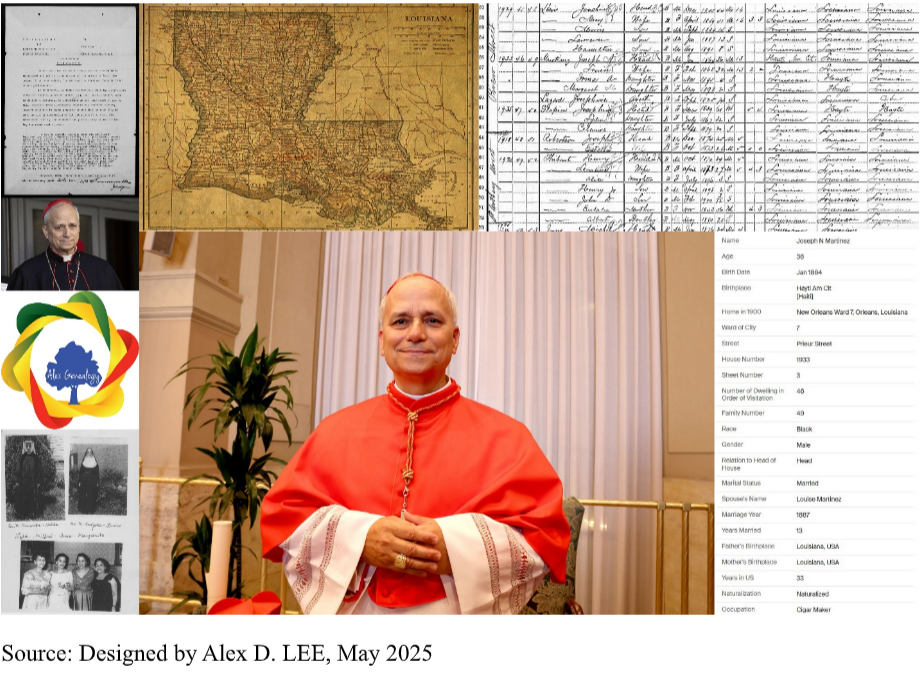
When Pope Leo XIV recently acknowledged and apologized for the Catholic Church's historical role in slavery, it reignited conversations about one of the most difficult chapters in human history. For many people, slavery is often viewed through simplified narratives that divide individuals into categories of enslaved and enslaver, victim and oppressor. Yet for those of us who spend our lives researching original records, particularly in places such as St. Landry Parish, Louisiana, the documentary evidence often reveals a reality far more complicated than modern assumptions allow.
Ironically, Pope Leo XIV himself descends from individuals whose lives touched multiple sides of that history. Among his ancestors were people who survived the horrors of the Middle Passage and the transatlantic slave trade and whose descendants endured bondage in colonial Louisiana. Yet among his ancestral lines were also free people of color who accumulated wealth, land, livestock, and, in some instances, enslaved laborers. This reality is not unique to Pope Leo's family. Rather, it reflects the complicated social and economic structure that existed in colonial and antebellum Louisiana where race, freedom, religion, family, and property ownership frequently intersected in ways that challenge modern perceptions.
For nearly two decades, my work has centered on exploring the genealogies of families from Southwest Louisiana and the broader Gulf Coast Diaspora. What began as an effort to understand my own family history after viewing a photo of my late great grandfather Alex LAFLEUR, Sr., of Grand Prairie, has gradually evolved into documenting thousands of interconnected families whose stories stretch across Louisiana, Texas, Mississippi, Alabama, and beyond. Along that journey, I have learned one important lesson: history is rarely as simple as people want it to be.
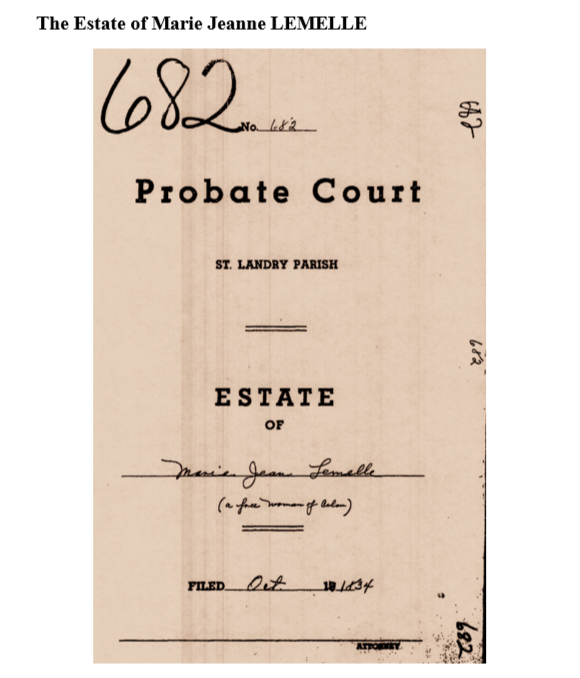
One example can be found in the 1834 succession of Marie Jeanne LEMELLE, a free woman of color and longtime consort of colonial militia officer Francois LEMELLE. Upon her death in St. Landry Parish, her estate was inventoried and valued at $6,693.75, a substantial fortune for the period. Among the property listed within her succession were nine enslaved people of color who were subsequently sold at public auction.
JEAN PIERRE (N), age 45 (born about 1789), was appraised at $800 and sold to Elias STEEN for $1,040 with John Wesley SINGLETON serving as security.
JEAN (N), age 47 (born about 1787), was appraised at $800 and sold to Francoise BRUNET, a free woman of color and wife of Jean GALLOT, a free man of color, for $620 with the advice and consent of her husband.
EVA (N), age 30 (born about 1804), together with her three children SIDONIA, age 9, ALSIN, age 6, and COMB, age 2, were appraised collectively at $1,400 and sold to Alfred LEMELLE, a free man of color, for $1,600. Edmond DONATO, a free man of color, signed as security for the purchase.
ANDRINETTE (M), age 16 (born about 1818), was appraised at $700.
EUPHEMIE (M), age 12 (born about 1822), was appraised at $500 and sold for $600 to Catiche LEMELLE, a free woman of color and daughter of the deceased Marie Jeanne LEMELLE.
ADELAIDE (N), age 50 (born about 1784), was appraised at $100 and sold to Francois LEMELLE for $235.
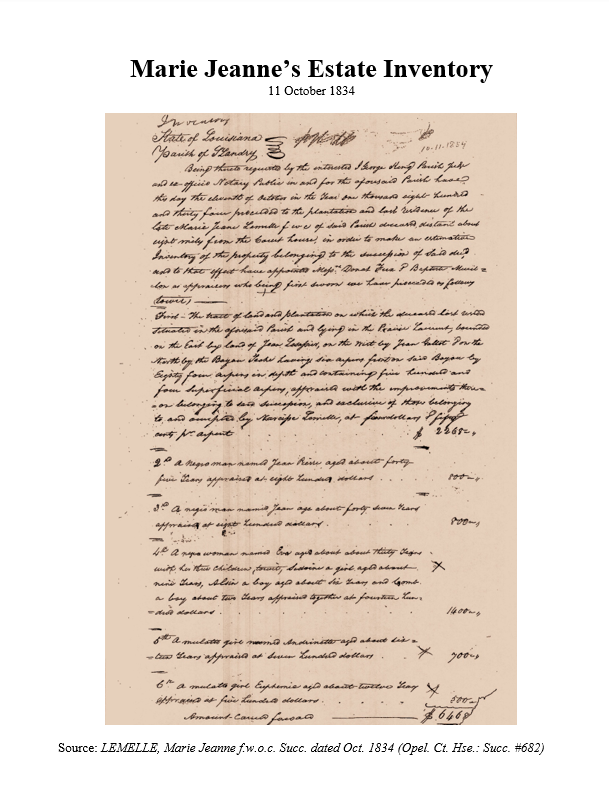
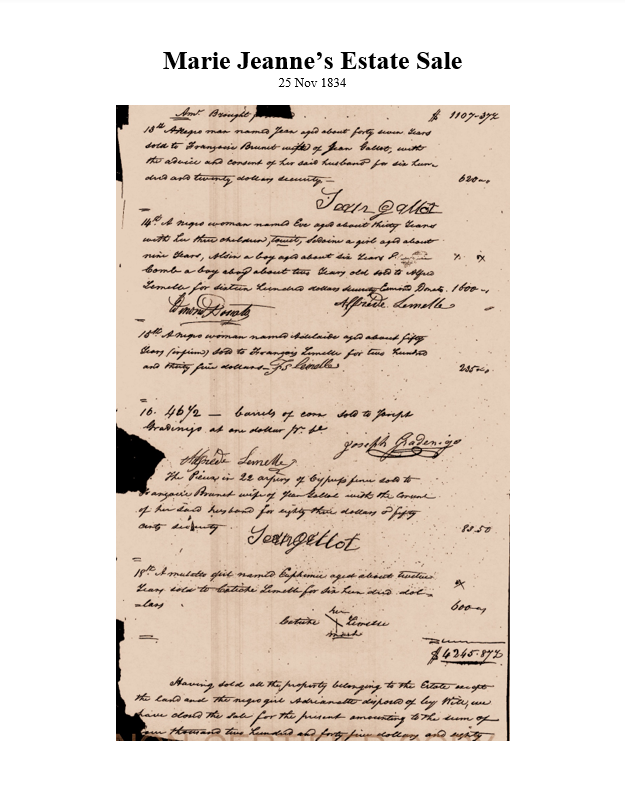
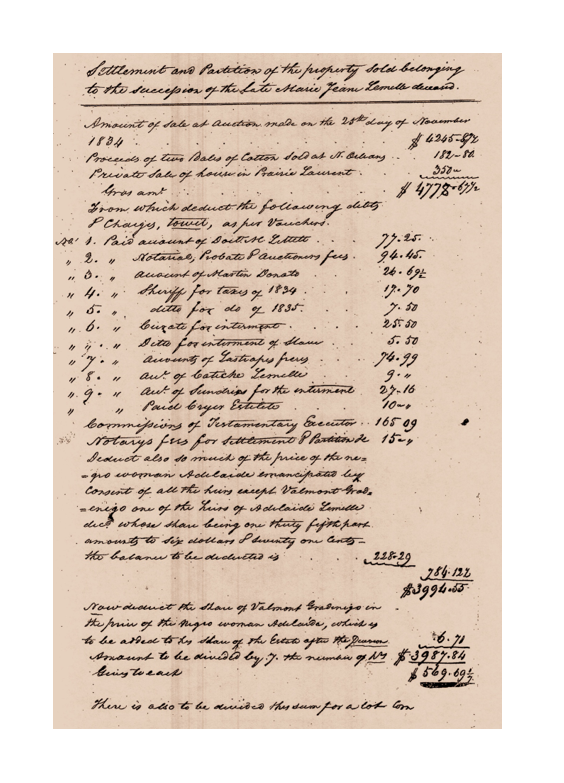
As shown, The succession records preserved the names, approximate ages, appraised values, purchasers, and securities associated with the sale.
For many people today, the immediate assumption is that free people of color who purchased enslaved individuals were simply buying family members in order to protect them or secure their eventual freedom. While that certainly occurred in Louisiana, records such as these demonstrate that the answer is not always that simple.
While Marie Jeanne’s descendants were listed as heirs of an inheritance, they directly benefited from her ownership of enslaved people, having the natural children of her son sold off.
Beyond the Family Protection Narrative
One of the most common statements made about slave ownership among free people of color is that enslaved individuals were purchased solely to protect family members. While there are documented examples supporting that conclusion, the historical record demonstrates that this explanation cannot be universally applied.
In the LEMELLE succession, one of Marie Jeanne's sons fathered children with an enslaved woman who remained in bondage within the family. That relationship undoubtedly created family ties between enslavers and enslaved persons. However, the remainder of the enslaved individuals listed in the succession cannot simply be explained away as family members being protected.
Like many slaveholders throughout Louisiana, free people of color could and did benefit economically from enslaved labor. The records reveal ownership, inheritance, valuation, and sale of human beings as property. To ignore that reality would be to ignore the evidence preserved in the historical record.
The lives of free people of color in Louisiana were complex. Some purchased relatives to protect them. Some emancipated enslaved individuals. Some inherited enslaved laborers through family successions. Others retained ownership for economic reasons. The records demonstrate all of these realities.
Perhaps no story illustrates this complexity better than that of sisters ANDRINETTE LEMELLE and EUPHEMIE LEMELLE.
The Sisters Who Fought for Their Children's Freedom
Years after their sale from the LEMELLE succession, both ANDRINETTE and EUPHEMIE would become involved in one of the most remarkable legal battles involving freedom in nineteenth-century Louisiana.
By September 19, 1848, ANDRINETTE and EUPHEMIE had been sold by their paternal aunt, Catiche LEMELLE, to Charles MARAN and were subsequently taken to New Orleans. What followed demonstrates that freedom was not always secure, even for people who had long lived as free persons.
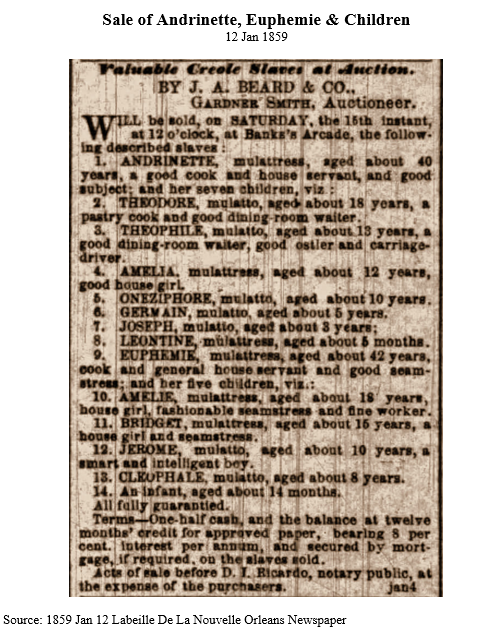
On January 13, 1859, newspapers in New Orleans reported that EUPHEMIE, described as a free woman of color approximately forty-two years old, sought an injunction to prevent herself and her children from being sold into slavery by J. A. BEARD & Co. at the request of Juliette MARAN, a free woman of color, and J. B. NOBLE, alias Jordan, also a free person of color.
According to the petition, EUPHEMIE and her children, EMILY, age 18, BRIDGET, age 11, JEROME, age 10, CLEOPHAS, age 14 months, JULES, age 20, and CORNELIUS, age 11, had been advertised for sale at a slave trader's yard. EUPHEMIE alleged that she and her children had always enjoyed their freedom and had been recognized as free persons within society. She further alleged that Juliette MARAN and Jordan had conspired to deprive them of that freedom and sell them into slavery for profit.
The injunction was granted, and newspaper reports noted that the sheriff removed the family from the slave trader's yard and placed them under the protection of the law while the matter proceeded before the courts. EUPHEMIE additionally sought $5,000 in damages for injuries suffered by herself and her children.
On the same day, ANDRINETTE filed a similar petition seeking to prevent the sale of her children: THEODORE, age 28, THEOPHILE, age 13, AMELIA, age 12, ONESIPHORE, age 10, GERMAIN, age 5, JOSEPH, age 3, and LEONIDAS, age four months.
ANDRINETTE alleged that she and her children had always enjoyed their freedom until only days before, when they were seized and taken to a slave trader's yard to be sold as slaves. Her petition was likewise granted, and her family was placed under the protection of the law.
The litigation ultimately reached the Louisiana Supreme Court. In the case of Euphemie, free woman of color, for herself and children versus Juliette, Jordan et al., the judgment of the lower court was affirmed. A similar ruling protected ANDRINETTE and her children.
What makes this case particularly remarkable is the identity of those accused. The women alleged that Juliette MARAN, herself a free woman of color and paternal aunt to some of the children involved, participated in efforts to sell her own nieces and nephews into slavery.
This reality directly challenges the notion that every transaction involving free people of color and enslaved individuals was motivated by family protection. According to the petitions, profit rather than kinship appears to have been the motivating factor. The allegations reveal a painful truth often absent from popular discussions of slavery: family relationships did not always override economic interests. Human greed, financial incentives, inheritance disputes, and personal conflicts existed within every segment of society.
The Proof of Slave Ownership
Ironically, some of the same church records documenting Pope Leo XIV's Louisiana ancestors also intersect with records revealing the Catholic Church's direct participation in slavery.
One example appears in the succession of Father Henri Don Flavius ROSSI, a Catholic priest serving the church in Opelousas, St. Landry Parish, where several of Pope Leo's Louisiana ancestors were baptized, married, and buried.
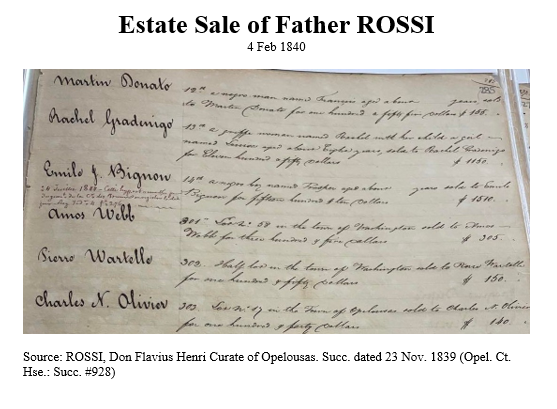
Following Father ROSSI's death, his estate included enslaved individuals who were sold at public auction.
Martin DONATO, a free man of color, purchased an enslaved man named FRANCOIS for $155.
Rachel GRADENIGO, a free woman of color, purchased an enslaved griffe woman named RACHEL and her daughter LOUISE for $1,150.
Emile BIGNON, a wealthy merchant originally from Germany, purchased an enslaved negro man named PROSPER for $1,510.
Many years before Father ROSSI's death, Martin DONATO and Jean José LOUAILLIER of Paris, France, co-owner of the commercial firm LOUAILLIER Brothers, signed as security for Father ROSSI in the purchase of a young, enslaved child named PHILLIP, approximately ten years old, from the succession of Marie PRUDHOMME.
As many would assume, Martin DONATO and Rachel GRADENIGO were likely purchasing family members. While that was certainly possible, the historical record demonstrates that such assumptions must be approached with caution. In numerous cases throughout Louisiana history, free people of color purchased spouses, children, siblings, or other relatives with the intention of protecting or eventually emancipating them. In other cases, however, enslaved individuals purchased by free people of color were not biologically related to their purchasers.
Martin DONATO himself provides an excellent example of why documentation matters. Upon his death, he secured the freedom of his natural children, grandchildren, and Sabin DONATO, who was not biologically related to him. Such actions remind us that family obligations, personal relationships, religious convictions, and humanitarian concerns often extended beyond bloodlines.
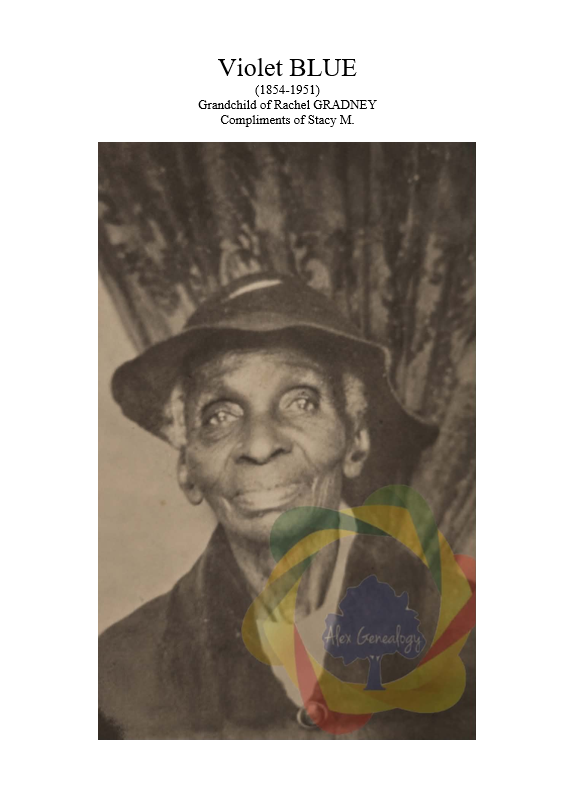
The only individuals from Father ROSSI's succession whom I have positively identified are Rachel GRADENIGO, known today through the surname GRADNEY, and her daughter Louise JOSEPH. Several years ago, I was commissioned by Rachel's descendants to research her family history. That research ultimately led me to this succession and the individuals connected to it.
When Slave Ownership Became Church Business
Another aspect of slavery that many people are unaware of today involves religious orders and convents.
On September 20, 1848, before Louis A. PATIN, Notary Public, Emilienne TRICHELLE, one of the Ladies of the Order of the Sacred Heart at Grand Coteau, Louisiana, appeared and, for the sum of $1,000 cash in hand paid, transferred ownership of four enslaved individuals to Maria CUTTS, also of the Order of the Sacred Heart.
The transaction included CAROLINE, age 26 (born about 1822), together with her children JOSEPHINE, age 4, BENJAMIN, age 2, and MARIE LOUISE, age 2 months. The act specifically stated that all four were enslaved for life.
Emilienne TRICHELLE explained that she acquired them through the partition of the community estate of her deceased parents, Jean Baptiste TRICHELLE and Modeste FONTENOT of Natchitoches Parish.
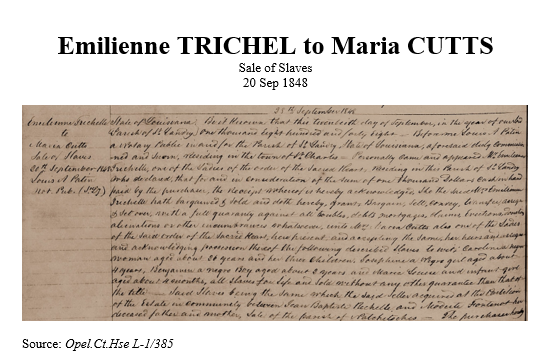
What I have learned through years of research is that when women entered religious orders and inherited enslaved people, those enslaved individuals often became church business. They were sold, transferred, inherited, and sometimes donated to religious institutions. This transaction provides a clear example of that reality. Here we find two Catholic women associated with the Order of the Sacred Heart at Grand Coteau transferring ownership of an enslaved mother and her children within a religious institution.
Because slavery is rarely taught at this level of detail, many people find it difficult to believe that Catholic nuns owned enslaved people. Yet the documentary record leaves little room for doubt. Maria CUTTS, who acquired CAROLINE and her children in this transaction, appears in the 1850 slave schedule with fifty-three enslaved individuals under her authority at the Sacred Heart institution. This was not an isolated occurrence but part of a broader system in which religious institutions participated in and benefited from slavery just as other sectors of Southern society did.
One of the greatest contributions to understanding this history came from Father Donald J. HÉBERT. Through his supplemental volumes and painstaking extraction of sacramental records from Southwest Louisiana churches, Father HÉBERT documented countless references to enslaved individuals, their families, enslavers, baptisms, marriages, burials, and relationships. His meticulous work preserved information that otherwise would have remained buried within church registers.
Because of that documentation, descendants searching for enslaved ancestors now have access to evidence that can reconnect families separated by slavery.
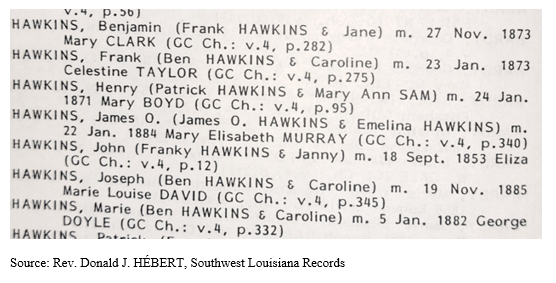
The value of that work is demonstrated by this very family. Through Father HÉBERT's documentation and surviving church records, I was able to identify CAROLINE and her children as members of the HAWKINS family. Among those records is the marriage of BENJAMIN HAWKINS, son of Frank HAWKINS and Jane, who married Mary CLARK on November 27, 1873. That BENJAMIN corresponds to the two-year-old enslaved child listed in the 1848 transfer between Emilienne TRICHELLE and Maria CUTTS.
Through church records preserved decades after emancipation, an enslaved child listed merely as property in a notarial act emerges as a husband, father, parishioner, and member of a documented family.
That transformation from property to person is precisely why records matter.
Why These Records Matter
What I appreciate about researchers such as Father Donald J. HÉBERT is that he did not hide these records. He documented them. Because of his meticulous work and the efforts of countless archivists, genealogists, and historians, descendants today can identify enslaved ancestors who otherwise would have remained anonymous. I am a perfect example of that. Through Father HÉBERT's supplemental volumes documenting the baptisms, marriages, and burial records of formerly enslaved Catholics throughout Southwest Louisiana, I was able to identify the HAWKINS family shown here.
History is not divided neatly between heroes and villains. It is made up of real people navigating complicated circumstances, making difficult decisions, and living within systems they did not create but nevertheless had to confront. The deeper one researches, the more one realizes that assumptions often collapse under the weight of documentation.
This is why I have devoted so much of my life to preserving, transcribing, translating, and organizing records. Whether the records involve Pope Leo XIV's ancestors, the LEMELLE family, Martin DONATO, Rachel GRADENIGO, the HAWKINS family, or countless others throughout Southwest Louisiana, my responsibility remains the same: follow the documentation wherever it leads.
As I often tell people, documentation trumps speculation every single time.
The records do not care about our modern politics, ideologies, or assumptions. They do not change to fit the narrative we wish existed. They simply preserve the lives of the people who came before us. Sometimes those stories are inspiring. Sometimes they are uncomfortable. Most often, they are far more complicated than we imagined.
If we are willing to listen, the records will tell us the truth.
And in Louisiana, that truth is often far more fascinating, far more complex, and far more human than anything we could invent ourselves. The people of the past left us their stories in church registers, succession files, conveyance records, court proceedings, and notarial acts. My goal has always been to help them tell those stories in their own words through the documents they left behind.
That is why I continue doing this work nearly twenty years later. Not to prove a point. Not to fit a narrative. But to preserve the history, follow the evidence, and give a voice to people whose stories might otherwise be forgotten. The deeper I dig, the more I realize that Louisiana's history is not black and white. It is layered. It is complicated. It is uncomfortable at times. But above all, it is human. If we truly want to understand where we came from, we have to be willing to accept the history as it was, not as we wish it had been. Documentation over speculation. Every time.
Call To Action
Beyond the documents, I hope this article encourages people to do something even more important: go experience the places connected to your family history. Visit the communities where your ancestors were born. Walk through the cemeteries where they were laid to rest. Spend time in the courthouses, churches, libraries, and archives where their stories were recorded. Pull those old photographs out of boxes and albums and scan them before they are lost forever. Sit down with elders and have conversations about family history while they are still here to tell their stories.
Legacy is not preserved by accident. It is preserved through intentional effort. Every photograph identified, every document transcribed, every family story recorded, and every cemetery visited helps ensure that future generations will know who came before them.
For those with ties to Southwest Louisiana, this has become one of my personal initiatives. For nearly two decades I have dedicated my life to preserving the histories, genealogies, photographs, records, and stories of the families who helped build this region and whose descendants became part of the Gulf Coast Diaspora. My hope is that this work inspires others to do the same within their own families.
We often inherit more than land, heirlooms, or surnames. We inherit stories. Some are inspiring. Some are painful. Some challenge everything we thought we knew. Yet all of them deserve to be remembered.
One day we too will become the ancestors. The question is whether we will leave behind enough for future generations to know who we were.
So visit those ancestral communities. Walk those cemeteries. Preserve those photographs. Record those conversations. Search those archives. Tell those stories.
Because once a story is lost, recovering it becomes much harder. But when it is preserved, it becomes part of a legacy that can live for generations. For those of us connected to Southwest Louisiana, preserving that legacy is not simply a hobby. It is a responsibility.