
The Family Genealogy of Bobby Seale, Co-Founder of the Black Panther Party

I know many of you are familiar with my genealogical works on Southwest Louisiana, however, I do genealogy in general, especially as someone who is part of the Louisiana Creole migration to Southeast Texas. That lived experience fuels my passion and purpose. This now marks the beginning of a new research collaboration project, focused on discovering more about the migration of families to the great state of Texas. There’s a rich, untold story woven into those journeys, and we’re ready to uncover it.
Tracing PETER SEALE, From Slave Labor to Black Legacy
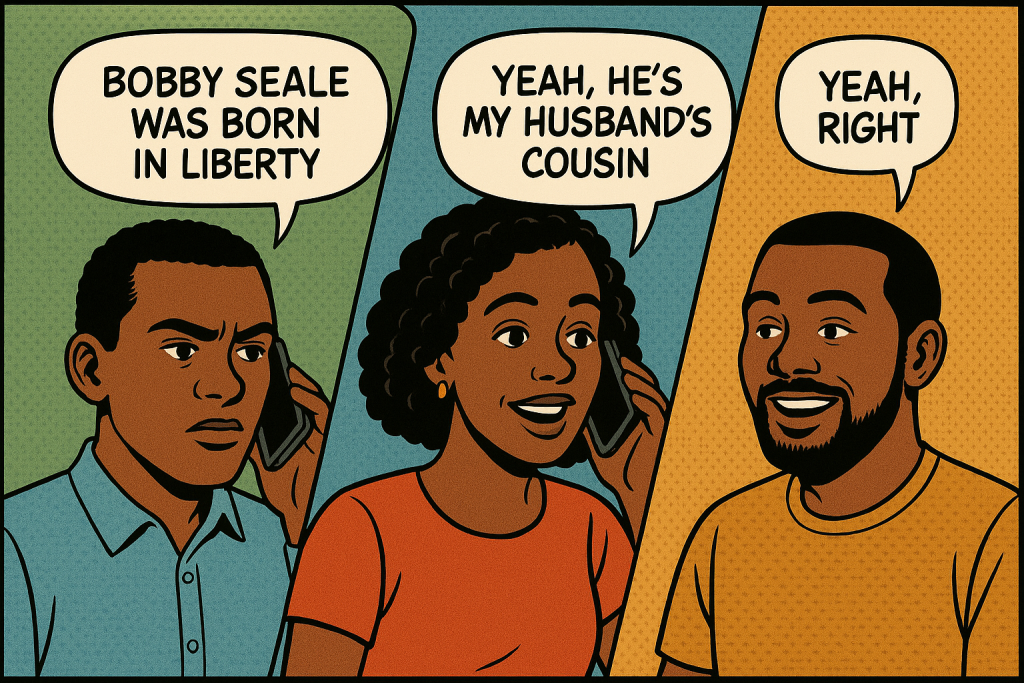
It all started during a conversation between Jamarlon GLENN, Robyne LARKING-DAMOND, and me. Out of nowhere as we conversed about Texas history, Jamarlon said, “You know Bobby SEALE, the co-founder of the Black Panther Party, was born in Liberty, Texas.” Robyne also stated he was also a relative of her husband and that he was also related to Michael STRAHAN. Now, with Jamarlon being from Liberty County, I figured he was just talking. I told him straight up, “Ain’t no way.” That’s when he bet me $10,000 that he was right.
Well, let’s just say Jamarlon earned bragging rights that day, because he was absolutely right, Bobby Seale really was born in Liberty. That one statement lit a fire under me. I immediately started tracing Bobby’s family line, and that’s what led me to the name PETER SEALE, who turns out to be Bobby Seale’s great-grandfather.
Finding Peter in the 1870 Census

Source: Ancestry.com
I located Peter SEALE in the 1870 census, listed in household 739 in Jasper County, Texas, living with an older woman named Delila SEALS, aged about 42, born in Mississippi. Based on the age gap and household relationship, I assume Delila was his mother. Peter’s birthplace was Louisiana, while Delila and the other household members were born in Texas. One important detail that stood out, Peter was listed as Black, a key clue in verifying identity and tracking lineage after emancipation.
Just a few doors down, I also found a Jessie SEALE, also born in Louisiana, and also listed as Black. That wasn’t just a coincidence. Between the shared surname, Louisiana origin, and proximity, it’s highly likely Jessie, Peter, and Delila were all connected, perhaps as siblings or extended family, and were once enslaved together before being forcibly moved to Texas.
The Wealth Behind the Name
In household 745, not far from Peter and Delila, lived Elias F. SEALS, a white farmer from Mississippi. His real estate was valued at $7,500, and his personal property at $2,300, wealth that was likely obtained through land grants, free labor, or an inheritance passed down from generations before him. That kind of wealth didn’t just come from farming vegetables; it came from a system built on the backs of former slaves held in bondage at a price. With the same surname, same location, and historical context, the connection between Elias and Peter was unmistakable.
1870 Census Household of Elias F. SEALS (SEALE)
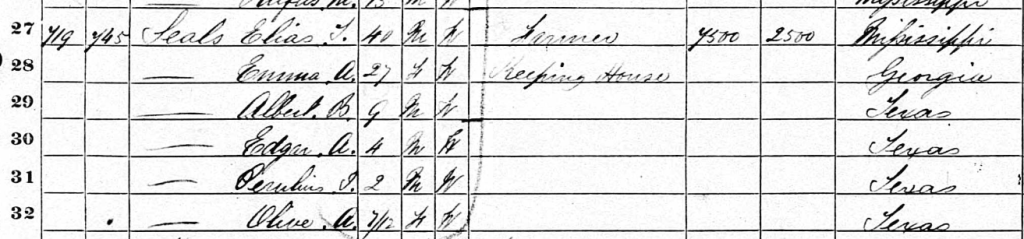
Source: Ancestry.com
I traced Elias back to his father, Lewis Perry SEALE (L.P. SEALE), a white planter originally from North Carolina. In the 1860 census, L.P. SEALE held over $14,000 in personal property, a direct indicator of the people he enslaved. By 1850, the family was in Union Parish, Louisiana, and slowly migrating westward, bringing enslaved laborers with them. By looking at the 1850 and 1860 census slave schedules, it’s clear that L.P. had a large number of slaves in both Union Parish and Jasper County, confirming that the Seale family maintained, and likely expanded, their forced labor operations across state lines.
Earlier still, in the 1840 census, L.P. SEALE was living in Jasper County, Mississippi (not to be confused by Jasper County, Texas), listed as holding five enslaved people. Based on their age ranges, Delila could very well be one of them. L.P. didn’t just operate in one state, he acquired property and land grants across Mississippi, Louisiana, and Texas. A key document, a land grant dated 1853, listed his residence in Jasper County, Texas. This was part of the broader westward expansion, as many white planters took advantage of growing their enterprises in the great State of Texas during its early statehood.
In 1853, President Franklin Pierce officially granted 79.65 acres of land located in Louisiana (East half of the NE quarter of Section 12, Township 72 North, Range 1 East) to Lewis P. SEALE of Jasper County, Texas. The land was purchased under the authority of an 1820 act of Congress for public land sales. The document formalizes Lewis P. Sale’s ownership of the land and guarantees full rights to him and his heirs.
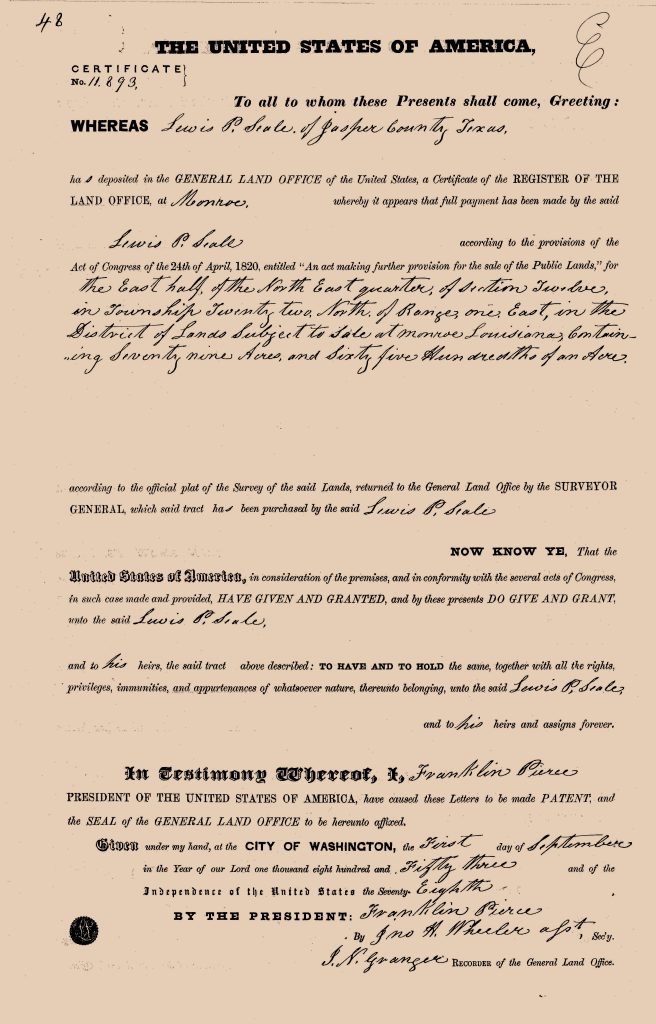
Source: Ancestry.com
1840 Census Slave Schedule of L.P. SEALE Living in Jasper County, Mississippi

Source: Ancestry.com
1850 Census Slave Schedule of L.P. SEALE Living In Union Parish, Louisiana

Source: Ancestry.com
The 1860 Deed That Tied It All Together
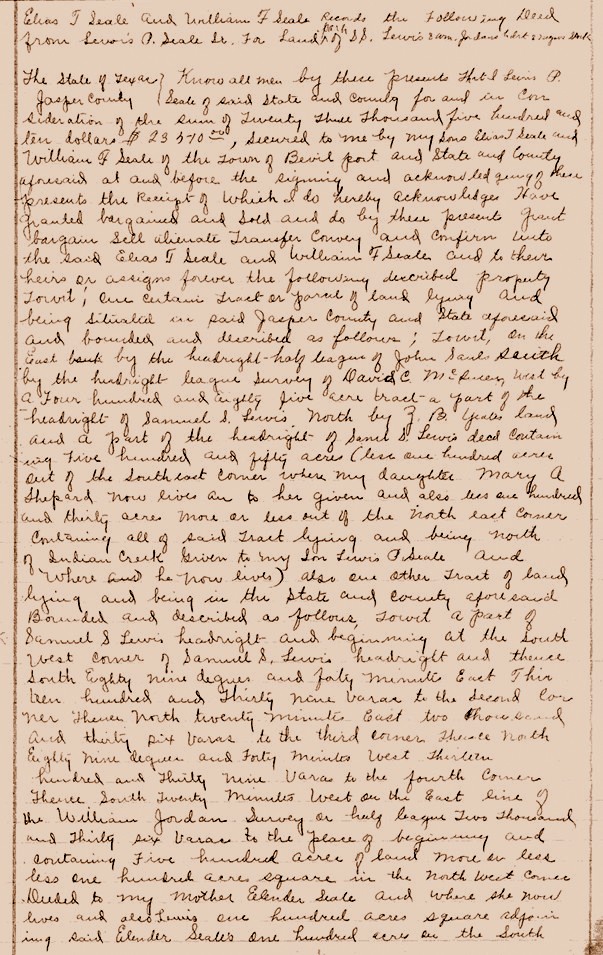
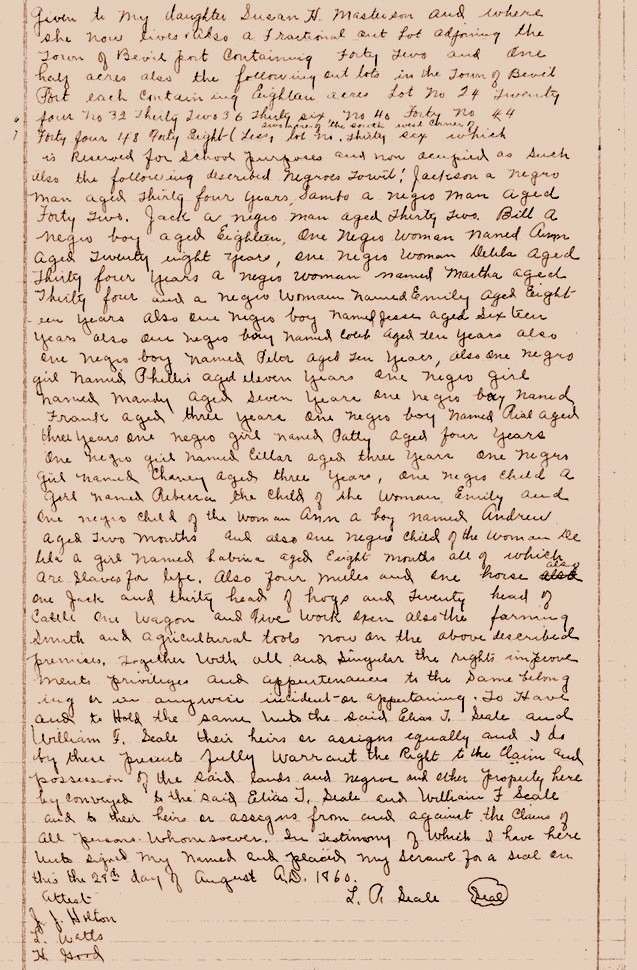
Source: Jasper County Clerk of Court
The key confirmation came through a deed dated August 28, 1860, filed in Jasper County, Texas, where L.P. SEALE transferred $23, 510 worth of assets ($854,824 today) including 22 enslaved individuals to his sons Elias and William F. SEALE. Among those listed:
- PETER, 10
- DELILA, 34
- JACKSON, 34
- SANTO, 40
- JACK, 32
- BILL, 18
- ANN, 28
- MARTHA, 34
- EMILY, 18
- JESSE, 16
- CALEB, 10
- PHILLIS, 11
- MANDY, 7
- FRANK, 3
- RIAL, 3
- PATTY, 4
- PILLAR, 3
- CHAREY, 3
- REBECCA, child of EMILY
- ANDREW, child of ANN, 2 months
- SUE, child of DELILA
- SABRINA, 8 months
Each person was listed as a slave for life, passed down as property, but these were human beings, carrying names, histories, and futures that couldn’t be erased.
Here is Peter’s son Arch SEALE, the grandfather of Mr. Bobby SEALE
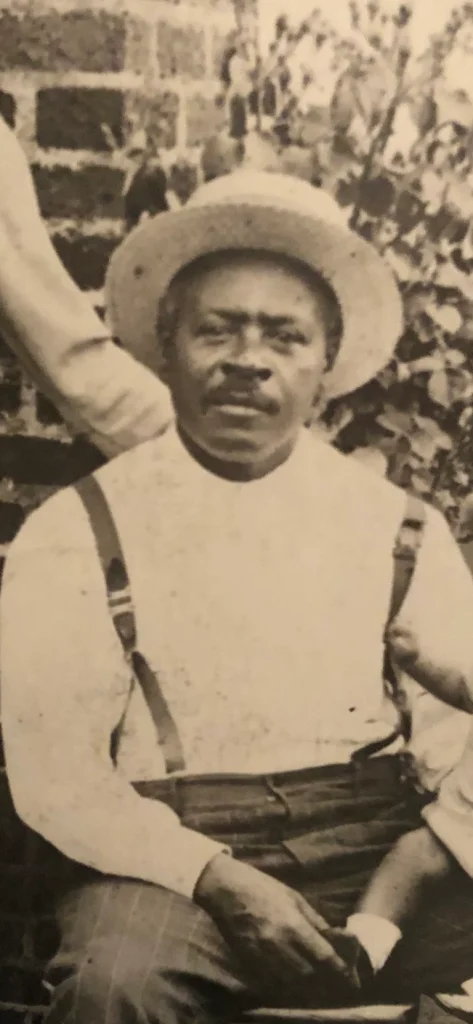
Source: coachmjones
From Enslavement to Empowerment
That same Peter, written into a deed as a 10-year-old enslaved child, would go on to become the great-grandfather of Bobby SEALE, co-founder of the Black Panther Party, a man who would challenge the system that once owned his family. That’s not just genealogy, that’s transformation.
It’s a full-circle moment, a family once held in bondage would later raise a son who helped launch a national revolution in Black pride, resistance, and self-determination. Bobby’s mission was to protect the best interests of Black Americans, who had long been underserved, underrepresented, and given the bare minimum by broken systems that were never designed with them in mind.
And there’s more. Bobby’s mother was born in Jasper County, the very same place where, years later, the world would witness the tragic racial killing of James Byrd Jr., a landmark act of racial violence that shocked the nation. It’s no wonder Bobby’s family, like many others, left that region, fleeing not just economic hardship, but the deeply embedded racial terror that made safety uncertain. Their migration was more than just relocation; it was about survival and dignity.
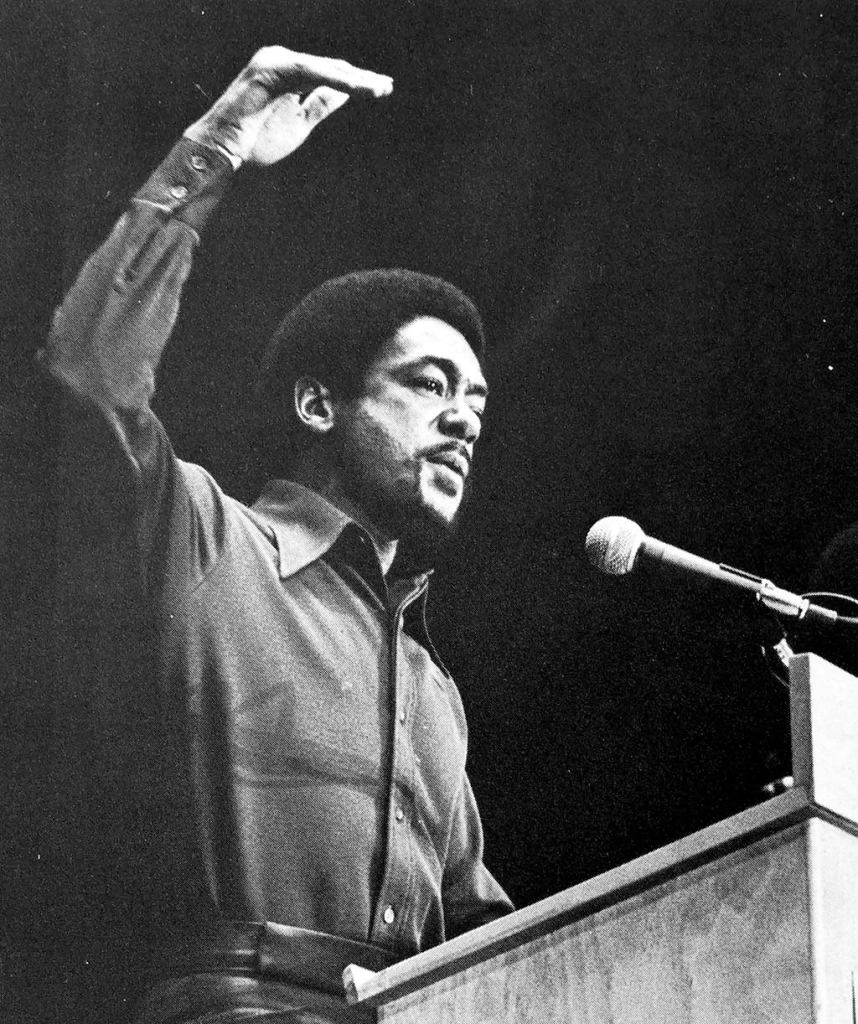

Source: The funeral of Black Panther Bobby Hutton 04/17/1968 Bobby Seale Speaks at the scene of the shoot out. Photographer Unknown/The Chronicle
The Road to Oakland

Source: https://www.visitoakland.com/blog/post/black-panther-party/
What makes this even more powerful is understanding the larger picture. Many Black families from Louisiana and East Texas, including Jasper and St. Landry Parish, later migrated to Oakland, California, looking for safety, jobs, and community. It was there, in Oakland, that Black people began shaping early political consciousness, community defense, and cultural pride.
In fact, I came across a free man of color from St. Landry Parish who had settled in Oakland long before the Civil Rights Movement during the 1850s. He was involved in community building, organizing, and Black uplift. His presence helped shape a community that Bobby Seale would one day step into, possibly continuing the very legacy he helped establish.
Full Circle History
During a quick search, I uncovered a powerful full-circle story. Peter, once written into a deed as property, later stood as the great-grandfather of Bobby SEALE, co-founder of the Black Panther Party. Delila, a woman born in Mississippi, survived the trauma of displacement and enslavement, making her way to Texas where she likely raised Peter. Living nearby was Jessie, also Black and born in Louisiana, possibly Peter’s brother, tied to the same journey. The SEALE name, once belonging to white enslavers, was eventually carried by revolutionaries who stood up to the very systems their ancestors endured. And at the heart of it all is Bobby, standing tall on the shoulders of Peter, Delila, Jessie, and so many others, marching, organizing, and defending his people with pride and purpose.
In this case, this is why it’s important for Black families to hold on to their names. Had Peter ever changed his surname, I might not have been this successful in tracing his story, a story that connects all the way back to an enslaved woman named Delila, born around 1818 in Mississippi. Her name could’ve easily been lost to history. But because that name stayed intact, we now know who Peter was and who he became the foundation for.
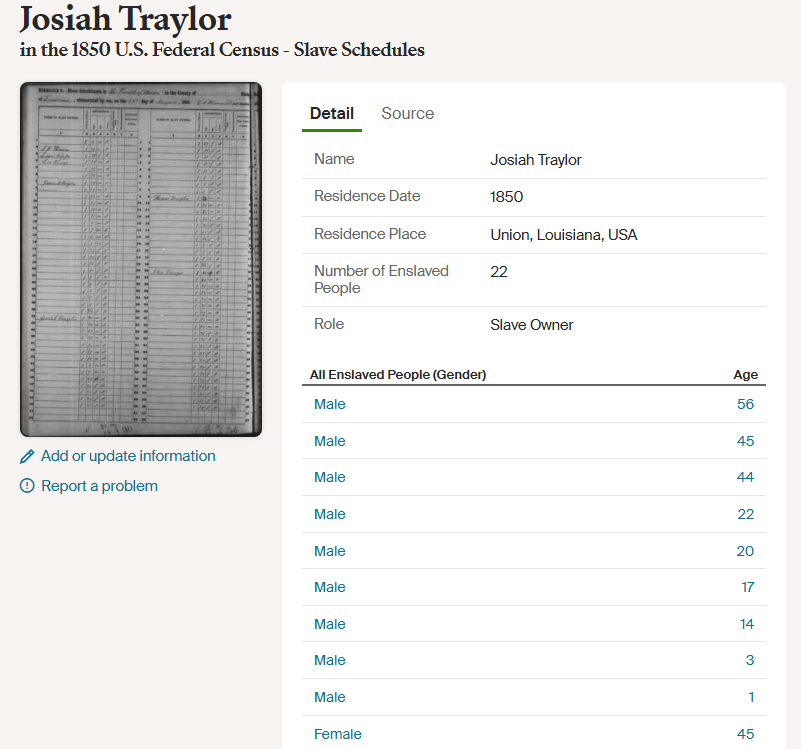
And before I close this out, I want to leave you with another powerful point, Bobby SEALE and NFL legend and hall of famer, Michael Anthony STRAHAN are both the sons of TRAYLOR’s, Thelma and Louise TRAYLOR. Based on my research, they are likely descendants of the enslaved families once held by the TRAYLOR brothers, associates of the SEALEs who made that same westward migration from Union Parish, Louisiana to Jasper and Newton Counties, Texas.

Source: https://www.instagram.com/p/DJhBuolRbyA/?img_index=2
Speaking of football! It may come as a surprise to some, but there is a remarkable family connection between Bobby SEALE, co-founder of the Black Panther Party, and former NFL linebacker Eugene Seale. Thanks to Jamarlon with another assumption of this kinship.
According to the 1910 U.S. Census, Rial SEALE, also known as R.C., the paternal great grandfather of Eugene, was listed as a cousin living in the household of Arch Seale, the grandfather of Bobby Seale. Rial was one of the slaves listed in the above 1860 slave sale. This means Bobby Seale and Eugene Seale share a close family tie, and it also shows how their families remained deeply connected across generations. Their shared lineage adds a compelling historical layer to both men’s legacies, one rooted in resilience, leadership, and generational strength.
1910 Census Household of Arch SEALE In Jasper County, Texas

Source: Ancestry.com
Eugene SEALE, Jr., was born on June 6, 1962, in Jasper, Texas to Eugene SEALE, Sr., and Dora HADNOT. He is a graduate of Lamar, University in Beaumont, Texas, my hometown. Despite going undrafted in 1984, he earned a spot on the Houston Oilers roster through a tryout, a rare and admirable achievement in professional football. Playing as a linebacker, he quickly stood out on special teams, earning the nickname “The Hitman” for his aggressive tackling and all-out style of play. SEALE served as special teams captain for much of his eight-year NFL career, widely respected by teammates and coaches alike. From 1985 to 1992, he played a key role in the Oilers’ playoff-contending teams, lining up with stars like Warren Moon and Ray Childress. Though never a headline-grabber, Seale built a solid reputation as a tough, dependable, and hard-hitting player.
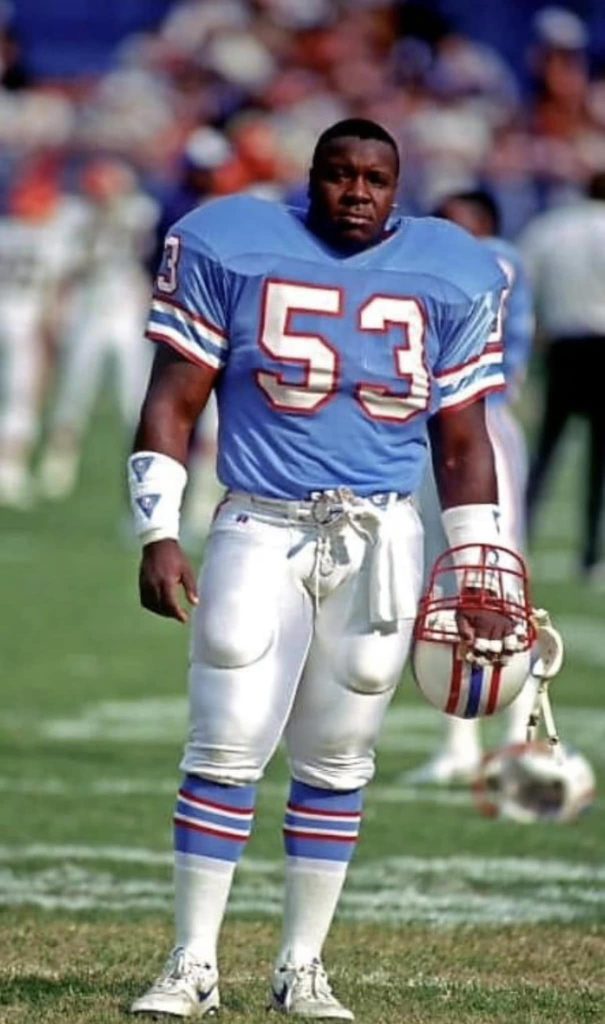
Source: Fair Share Image, Google
When viewed together, the stories of Bobby Seale and Eugene Seale reflect the remarkable reach of a single family, from the front lines of the civil rights movement to the hard-hitting fields of the NFL. It’s a legacy built on determination, courage, and an enduring connection to community and family. Eugene is also connected to the HADNOTs, another white planter family of Jasper County, Texas.
Families like the SEALEs, HADNOTs, and TRAYLORs would go on to be considered some of the early pioneering families of Jasper, Newton, and surrounding counties, having several Black families having their names who I can trace using documents of their ancestors only having forenames.
1850 Slave Schedule of Josiah TRAYLOR Living In Union Parish, Louisiana
Source: Ancestry.com
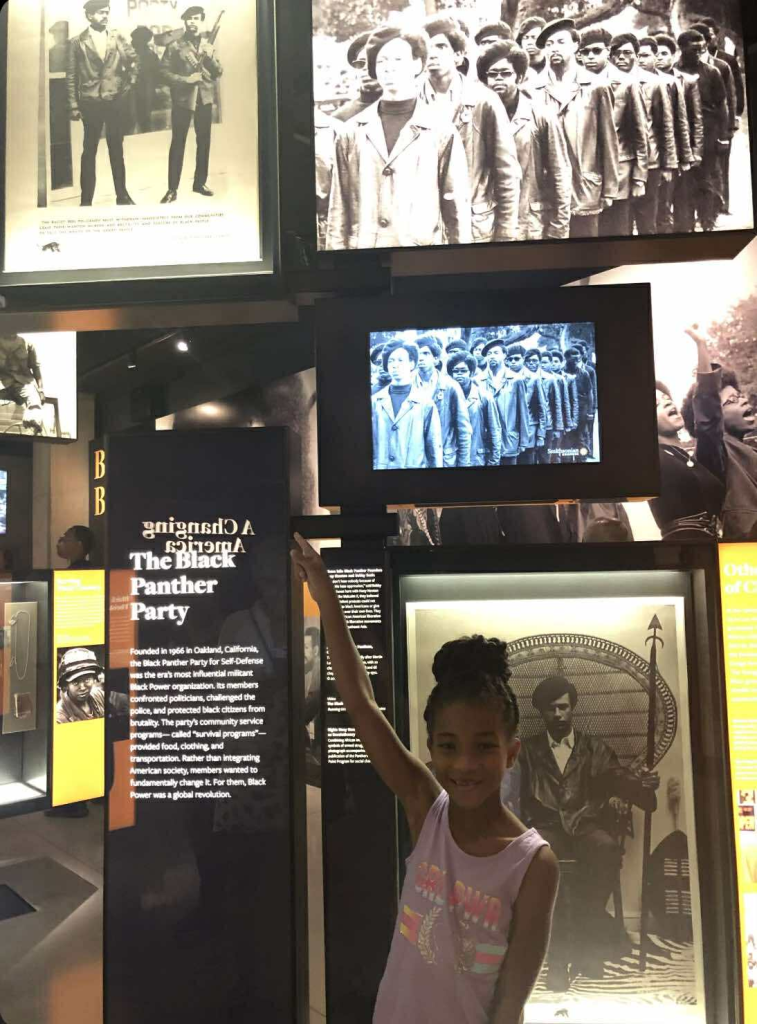
Haleigh DAMOND at the National Museum of African History and Culture, 2019
Source: Robyne Larking DAMOND
Now pictured here is a 2019 photo of Bobby Seale’s cousin, Haleigh DAMOND, daughter of Cody and Robyne, taken at the National Museum of African American History and Culture in Washington, D.C. Moments like these, family trips, standing in front of history, are how we keep the story alive. These kinds of family ventures help build cultural pride in our children, showing them who they come from and what their legacy is rooted in. We must keep learning about the past, so we truly understand just how far we’ve come. Our freedom and civil liberties today came at a tough cost, paid for by lives that were displaced, sacrificed, and often forgotten. Remembering them, honoring them, and walking through these museums with our heads held high is part of our healing and our power.
In all of my work, I don’t just say how many enslaved people were owned, I name them as well as capitalize their names. These were real individuals with names, lives, and descendants who are probably out there right now searching for them. I will not omit them, and I will not conform to the erasure of people who didn’t have the free will to move, speak, or live freely. Naming them is an act of restoration, a refusal to let their identities be buried under numbers or silence. They mattered then, and they matter now.
The names tell the story; we just have to follow them.
Stay tuned for more.